Predicting relapse risk in first episode psychosis using machine learning and sleep data – Translational Psychiatry
Sleep disturbance is common in First Episode Psychosis (FEP) and is associated with psychosis symptom exacerbation and functional decline, yet it remains unclear which sleep features predict relapse. In this longitudinal study, 269 FEP participants reported daily sleep during the first 30 days of the 12-month follow-up period via a smartphone app, including difficulty falling asleep, wake-up frequency, insufficient sleep, and sleep duration. These sleep characteristics were used to predict relapse and positive symptoms over the 12-month follow-up period, with outcomes assessed using structured interviews and clinical records. A Random Forest classifier was developed and validated using stratified nested cross-validation, achieving an AUC of 0.75 ± 0.13 and accuracy of 0.72 ± 0.16. Insufficient sleep and irregular sleep duration were identified as the strongest predictors of relapse risk. These findings were used to develop an open-access interactive web-based platform (a research prototype not intended for clinical use) to predict risk of relapse based on sleep disturbance, demonstrating the potential for real-time monitoring and personalised relapse prevention.
PubMed/関連情報:
PubMed
PubMed® comprises more than 40 million citations for biomedical literature from MEDLINE, life science journals, and online books. Citations may include links to full text content from PubMed Central and publisher web sites.
The genetic overlap between schizophrenia and major depression with cognitive function – Molecular Psychiatry
This study aimed to systematically dissect the shared genetic basis of schizophrenia (SCZ) and major depression (MD) with cognitive function. To investigate this, we integrated large-scale genome-wide association studies (GWAS) summary statistics for SCZ (N = 175,799, [cases, 74,776; controls, 101,023]), MD (N = 2,622,273 [cases, 550,355; controls, 2,071,918]) and four cognitive traits (reaction time, N = 330,069; memory, N = 112,067; verbal-numerical reasoning, N = 36,035; educational attainment, N = 111,114). Linkage disequilibrium (LD) score regression analysis revealed that SCZ showed significant negative genetic correlations with reaction time, memory, and verbal-numerical reasoning. MD showed negative genetic correlations with memory, verbal-numerical reasoning, and educational attainment. Bayesian colocalization analysis identified seven genomic regions with strong or supportive evidence between SCZ and cognitive function, and two genomic regions with supportive evidence between MD and cognitive function. Gene mapping and over representation analysis (ORA) indicated that SCZ-associated genes were primarily involved in pathways related to transport processes, and MD-associated genes were significantly enriched in pathways related to neural development. Through genetic correlation and colocalization analysis, this study elucidates the genetic overlap between SCZ and MD with cognitive function, providing a new perspective for related research.
Prevalent and characteristic alterations in blood-brain transcriptomic-functional imaging coupling in schizophrenia – Molecular Psychiatry
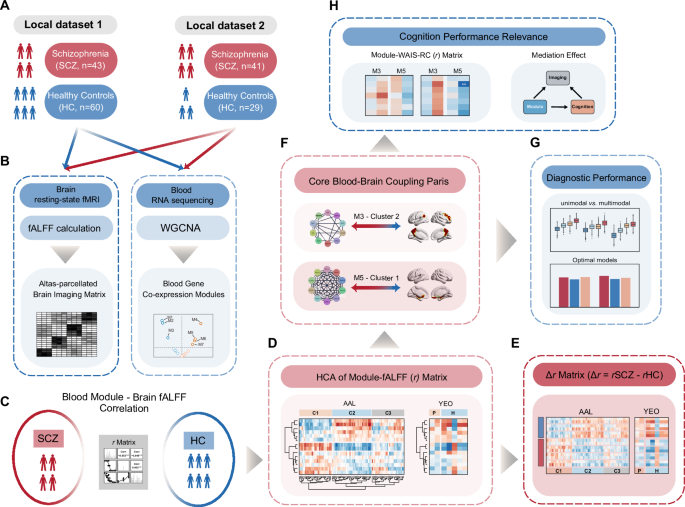
Schizophrenia (SCZ) is increasingly recognized as a multi-system disorder characterized by peripheral immunometabolic dysregulation. To investigate system-level blood-brain integration, we analyzed peripheral blood transcriptomics, resting-state fMRI (fALFF), and cognitive data from two cohorts (Discovery: 43 SCZ, 60 HCs; Validation: 41 SCZ, 29 HCs). Seven robust peripheral blood gene co-expression modules associated with SCZ were identified, enriched for immune and metabolic pathways. These modules showed reproducible disease associations in independent blood cohorts. Widespread alterations in functional coupling between these gene modules and intrinsic brain activity (fALFF) were observed in SCZ, characterized by a network-specific reconfiguration with an inverse pattern of correlation changes between limbic and frontoparietal/default mode networks. This dysregulated coupling pattern was highly reproducible across cohorts. We further identified putative core disease-associated module-network pairs: a downregulated metabolic module coupled with frontoparietal/default mode regions, and an upregulated ribosomal module coupled with limbic regions. Integration of these multimodal features yielded a proof-of-concept improvement in SCZ diagnostic classification (AUCs: 0.71–0.77 in an independent temporal but local validation cohort). Correlation and mediation analyses suggested that brain functional activity in these coupled regions may mediate the relationship between peripheral gene expression and cognitive impairment. Collectively, these findings reveal distinct, reproducible dysregulation of peripheral-central functional coupling in SCZ, offering a multi-scale framework for understanding its pathophysiology and highlighting the potential of trans-scale features as candidate biomarkers for diagnosis and mechanistic insight.
PubMed:
pubmed.ncbi.nlm.nih.gov
非侵襲的脳刺激(TMS)で、統合失調症の認知機能障害を改善できる可能性
②発表日付 2026年9月10日
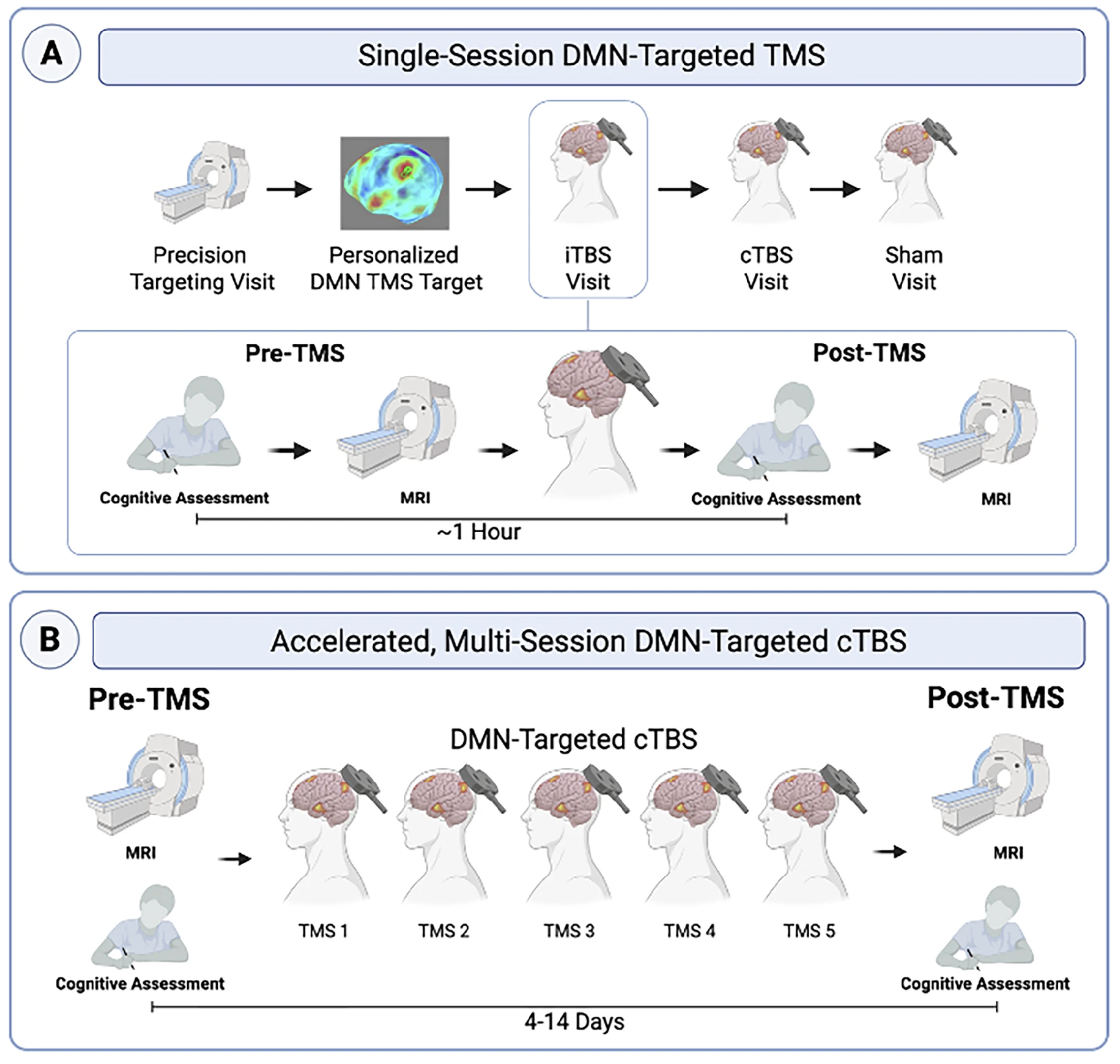
③内容要約 Vanderbilt Health が、Harvard Medical School との研究で、経頭蓋磁気刺激(TMS)を特定の脳領域に適用し、統合失調症または統合失調感情障害の認知機能を検討した研究を紹介した。 小規模な2群での検討ながら、特に若年者で情報処理速度の改善と認知機能障害の軽減が示唆された。単回刺激と、短期間に複数回行う加速型プロトコルを比較している。
HKUMed finds that long-acting injectable antipsychotics lower relapse in patients with bipolar disorder and older adults with schizophrenia
A research team from the Department of Pharmacology and Pharmacy, LKS Faculty of Medicine, the University of Hong Kong (HKUMed), has found that long-acting injectable (LAI) antipsychotics provide better treatment outcomes than oral antipsychotic medications for patients aged 65 and above with schizophrenia.
患者由来のヒト脳オルガノイドをマウス内で成熟させ、統合失調症などの研究に使える新しいモデルを構築
②発表日付 2026年9月16日
③内容要約 Stanford University の研究チームが、ヒト由来の脳オルガノイド(実験室で作った脳組織)を、特定の脳領域を欠損させた遺伝子改変マウスの脳内に移植し、ヒト神経組織を生体内で発達・機能させるモデルを報告した。 患者由来細胞から作った組織を生体内で観察できるため、統合失調症を含む精神・神経疾患の病態や薬物反応を研究する新しい実験基盤になる可能性がある。
なお、2026年9月1日付で『Pharmacological treatment of schizophrenia: Japanese Expert Consensus 2025』のversion of recordも公開されている。これは9月に入ってから利用可能になった重要な日本の薬物療法コンセンサスで、21の臨床状況について154人の専門医が評価し、治療抵抗性ではクロザピン、再発反復・服薬アドヒアランス不良などではLAIを重視するなど、現在の日本の実臨床を考える上で重要な資料である。
Pharmacological treatment of schizophrenia: Japanese Expert Consensus 2025 – Schizophrenia
Conventional schizophrenia treatment guidelines do not adequately address all clinically important issues in routine practice. This study aimed to update the 2021 expert consensus of the Japanese Society of Clinical Neuropsychopharmacology (JSCNP) to reflect the current clinical landscape. A total of 154 board-certified psychiatrists from the JSCNP and the Japanese Society of Neuropsychopharmacology (JSNP) evaluated treatment options across 21 clinically relevant situations using a 9-point Likert scale (1 = “strongly disagree”; 9 = “strongly agree”); the response rate was 44%. First-line antipsychotics varied by predominant symptoms: risperidone, brexpiprazole, olanzapine, paliperidone, and blonanserin for positive symptoms; aripiprazole and brexpiprazole for negative symptoms and cognitive impairment; aripiprazole, brexpiprazole, lurasidone, olanzapine, and quetiapine for depression and anxiety; brexpiprazole, aripiprazole, and olanzapine for disorganized thinking; olanzapine and risperidone for excitement and aggression; and aripiprazole, brexpiprazole, and lurasidone for social integration. Brexpiprazole, quetiapine, and aripiprazole were first-line options for patients at high risk of extrapyramidal side effects or diabetes mellitus. Dose reduction or switching was the treatment of choice for tardive dyskinesia. Repeated recurrence, patient request, and poor medication adherence were indications for introducing long-acting injectable antipsychotics. Switching to clozapine was the treatment of choice for treatment-resistant schizophrenia. Adverse effects were the highest-rated factor for both dose reduction and simplification to antipsychotic monotherapy. Second-generation antipsychotics were rated as first- or second-line options in most situations, whereas first-generation antipsychotics were generally rated as third-line. These recommendations provide practical guidance for treatment selection and shared decision-making in clinically challenging situations not adequately addressed by existing evidence alone.